Monday, 9:00 a.m. Over the weekend a sales assistant vacancy collected 214 applications, the manager of a new store needs twelve people before opening day, and half of the numbers on the call list are "out of reach". Sound familiar? High-volume hiring does not break down at sourcing, it breaks down at the speed of the first reply: while a recruiter sorts applications by hand and keeps redialing, the best candidates are already starting shifts with whoever answered first.
The good news: the first contact, the "what's the schedule? the pay? where is it?" questions and screening out clearly unsuitable applicants can be handed to a system. The recruiter then spends their time on people who are already ready to come in for an interview. Below we look at exactly where candidates get lost and how HRStream handles it.
The short version
- High-volume hiring means filling a large number of similar vacancies on a tight deadline: sales assistants, cashiers, couriers, call center operators, baristas.
- The biggest loss is the time to first reply: according to hh.ru, 40% of job seekers lose interest in a vacancy if they get no answer within 3 days.
- Manual calling does not scale: hundreds of applications per vacancy turn into hundreds of recruiter hours.
- The fix is to automate the first contact in a messenger and leave the face-to-face meeting and the decision to a person.
- In HRStream, AI scores resumes, runs the initial interview in WhatsApp and job board chats, and hands the recruiter a shortlist.
What high-volume hiring is and why it works differently
High-volume hiring (mass recruitment) is finding and hiring a large number of employees for similar positions within a limited time. Typical triggers are opening a new branch or store, a seasonal peak, launching a call center, or high turnover among frontline staff.
It differs from specialist hiring in more than volume. In specialist hiring, a recruiter searches for one hard-to-find professional and may spend a week negotiating with them. In high-volume hiring, candidates come to you, there are many of them, the requirements are simple, and a candidate makes up their mind within a day or two, usually choosing the employer who replied and invited them to an interview first.
| High-volume hiring | Specialist hiring | |
|---|---|---|
| Where candidates come from | They apply themselves: hh, OLX, social media, word of mouth | You have to find and persuade them |
| Volume | Dozens to hundreds of applications per vacancy | A handful of strong candidates |
| What decides the outcome | Speed of reply and an easy application | Depth of assessment and the offer |
| Where recruiter time goes | Initial review and phone calls | Search and interviews |
Where candidates get lost in high-volume hiring
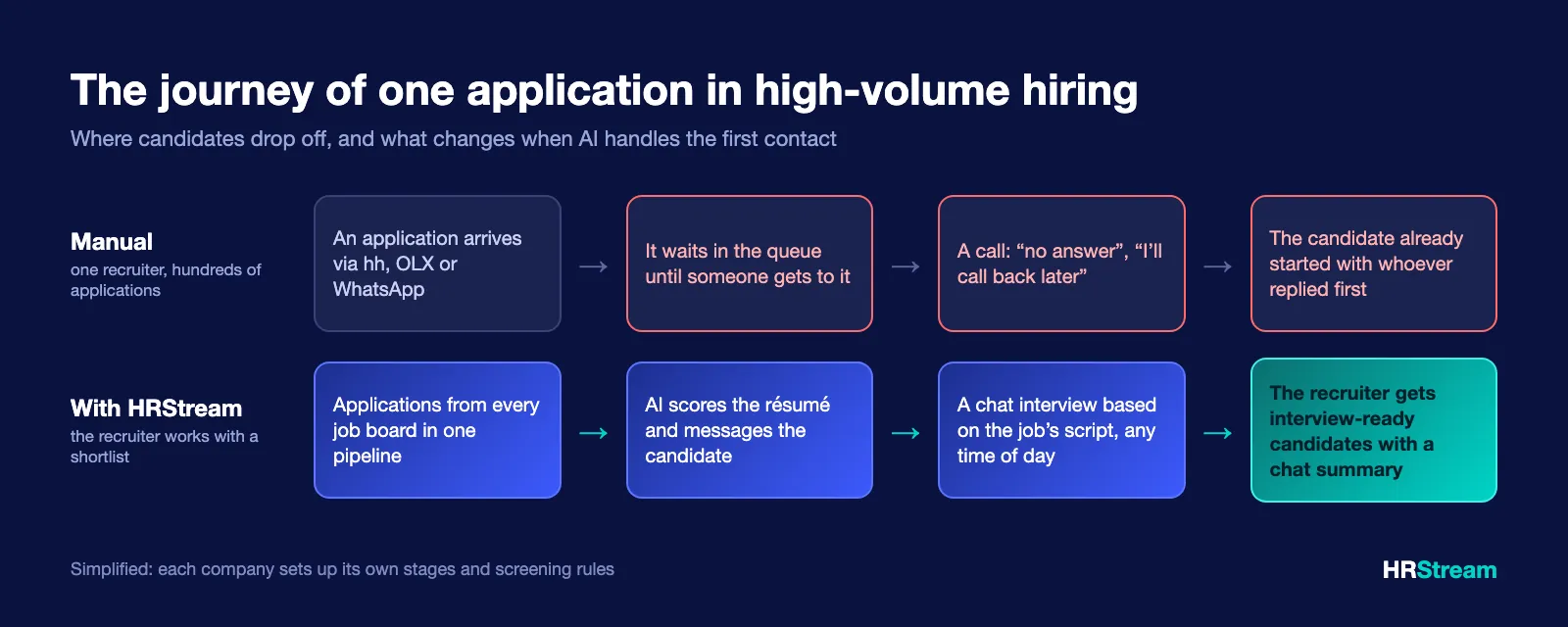
Candidates get lost in the gap between the application and the first conversation. The longer the gap, the more people find a job elsewhere in the meantime. Here are the four points where it happens most often.
1. The application sits in a queue
According to an hh.ru survey (2023, Russia, 2,200 job seekers), 40% lose interest in a vacancy if the employer does not reply within 3 days, and in sales and retail 54% of candidates are not willing to wait longer than three days. The same job board estimates that about 15% of applications "burn out": the person has already found a job before anyone gets through to them (hh.ru, in Russian).
2. Manual review cannot keep up with the flow
hh.ru offers an illustrative calculation: 80 vacancies with 100 applications each, a minute and a half to review and at least three minutes per call add up to about 587 working hours (hh.ru, 2023, in Russian). It is a model, not a measurement, but the order of magnitude is clear: even a team of several recruiters cannot handle that volume without falling behind.
3. The candidate does not pick up the phone
Applicants for frontline roles are often on shift, on the road, or simply do not answer unknown numbers. But they do read messengers: according to the "Youth of Kazakhstan 2024" report, 89.4% of young people surveyed use WhatsApp (Energyprom.kz, 2025). An unanswered call is one more delay, while a message can be read and answered during a break.
4. Managers cannot see the big picture
When ten stores are hiring at the same time, data scatters across spreadsheets, recruiters' personal WhatsApp accounts and job board dashboards. It is unclear where the pipeline is empty and where candidates are stuck waiting for approval. If a recruiter leaves, the conversation history leaves with their phone.
What a slow reply costs
Every candidate lost at the start means a new application that has to be attracted, reviewed and called all over again. And in Kazakhstan's high-volume segment, hiring never stops: according to EY, turnover among blue-collar workers in 2024–2025 was 24%, and among specialists 22% (EY, 2025, in Russian). According to Energyprom data reported by Inbusiness.kz, overall staff turnover in Almaty reached 37.9% in 2025, and 28.1% in Astana (Inbusiness.kz, 2026, in Russian).
Estimating the cost of the delay for your own company is simple: how many days on average pass between an application and the first contact, and what share of candidates "disappear" at that step. If the first figure is more than a day and the second is noticeable, this is your cheapest source of growth. More on the metrics in the article how to reduce time-to-hire.
Example: opening three coffee shops in a month
A typical situation (a composite example, not a specific client case): a coffee shop chain in Almaty is opening three locations and needs 30 baristas and cashiers. The vacancies are posted on hh.kz and OLX, and the link has been shared in group chats. Within a week there are several hundred applications.
- Without automation: one recruiter goes through applications in the evenings, reaches about a third of them, and by Friday some candidates have already started at the coffee shop next door. The store manager asks "how many people do we have?" and the answer has to be pieced together from three spreadsheets.
- With automated first contact: everyone who applies gets a message the same day, answers a couple of questions about schedule and experience, and learns about the pay and the address. In the morning the recruiter sees a list of people who fit and are ready to come in, and spends the day on interviews instead of dial tones.
The difference is not some "magic" technology. It is that the first reply no longer depends on how busy one person is.
How HRStream solves it
HRStream takes the routine of first contact off the recruiter and brings the whole high-volume flow into one place. Without going into setup details, here is what changes for the team.
All applications in one pipeline
Vacancies are published from HRStream, and applications from HeadHunter, Avito and OLX (OLX in Kazakhstan) go straight into the pipeline. One candidate, one profile: the system removes duplicates on its own. For chats and social media there is a single vacancy link that lets a candidate apply without installing any apps.
AI reviews resumes and reaches out first
The system reads the resume, checks it against the vacancy requirements and gives a score with a clear explanation (how AI screening works). Then the AI interviewer writes to the candidate in WhatsApp, Telegram, Max, by email or in the job board chat (HeadHunter Messenger and OLX Messenger) and asks questions from the vacancy's script in Russian or Kazakh. It works in the evenings and at weekends too, which is exactly when candidates tend to apply.
The candidate gets answers, not silence
The bot answers questions about schedule, conditions and address from the vacancy's knowledge base, and if there is no answer, it passes the question to the recruiter. A person can join the conversation at any time. After the interview, the candidate moves to the right stage according to rules set by the company, and those who pass screening can pick an interview time from the recruiter's free slots themselves. See how self-scheduling works.
Dozens of vacancies as one project
Similar vacancies (store openings, seasonal hiring, a call center) can be combined into a group with a shared pipeline and a summary across all of them. Analytics shows time to close, conversion by stage, recruiter workload and rejection reasons, and the history of communication with candidates stays in the system even if an employee leaves.
To be clear and honest: AI does not hire for you. It handles the first conversation and screening by clear criteria, while the hiring decision, the interview and the offer stay with people. For more on screening scenarios in messengers, see the article AI interviewer in WhatsApp for high-volume hiring.
Checklist: is your high-volume hiring ready for the flow?
- You know how many hours on average pass between an application and the first reply to the candidate.
- A candidate can apply and complete the first stage from their phone in a few minutes, without a call.
- Typical questions (schedule, pay, address, paperwork) get an answer right away, not "the recruiter will call you back".
- Applications from all job boards and chats are collected in one place, without copying between dashboards.
- Managers can see, for each location, how many people are at which stage, without asking a recruiter.
- Conversations with candidates belong to the company, not to an employee's personal phone.
If at least two answers are "no", start with the first contact: that is where high-volume hiring loses the most. Common process mistakes are covered in the article 5 mistakes in high-volume hiring.
Frequently asked questions
At what volume does hiring count as high-volume?
There is no strict threshold. People usually talk about high-volume hiring when you need to hire ten or more people for one or several similar positions on a tight deadline, and the flow of applications no longer fits into manual calling.
How quickly should you reply to a candidate in high-volume hiring?
The faster, the better; aim for the same day. According to an hh.ru survey, 40% of job seekers lose interest if there is no reply within 3 days, and in retail and sales candidates wait even less.
Can you run high-volume hiring through WhatsApp?
Yes, and for frontline roles it is often the most convenient channel: candidates read messengers more willingly than they answer calls. What matters is that conversations run from a work system rather than personal numbers, and are not lost when a recruiter changes.
Will talking to a bot put candidates off?
A quick and clear answer matters more to a candidate than who gave it. In HRStream, when asked directly, the bot honestly says it is an AI assistant, and a recruiter can join the conversation at any time.
Which metrics should you track in high-volume hiring?
The minimum set: time to first reply, conversion by pipeline stage, interview show-up rate, the share of candidates who start work, and turnover in the first months. The first two figures usually show where you lose the most people.
How much does automating high-volume hiring in HRStream cost?
You pay for active recruiter seats, and AI interviews in messengers are billed per conversation that actually took place. There is a 7-day free trial with full access; current prices are on the pricing page.
Reply to every candidate the same day
HRStream collects applications from all job boards into one pipeline, and the AI interviewer holds the first conversation in a messenger and hands the recruiter those who are ready to meet.