High-volume hiring is a race against the clock. Hundreds of applications a day, dozens of near-identical phone screens, candidates who go cold while the recruiter is still trying to reach them. The classic approach simply doesn't scale: to handle the flow, you either keep hiring more recruiters or accept that some candidates will never get processed at all. HRStream offers a third path — an AI interviewer that runs the initial screening right inside WhatsApp, and then invites qualified candidates to a live interview using the recruiter's own calendar. In this article we'll break down how it works and why it changes the economics of high-volume hiring.
Why high-volume hiring breaks the usual process
Picture a typical high-volume hiring funnel: a retail chain opens 50 cashier positions, a call center is staffing 30 operators, a logistics company needs 100 couriers. Each opening pulls in anywhere from 100 to 500 applications. Here's what happens next:
- First contact takes days. A recruiter physically can't call 300 people in a single day. By the time the queue reaches a candidate, they've already started work at a competitor.
- 80% of the time goes to filtering. Most calls are just checking basic criteria: age, required documents, availability for the schedule, location, salary expectations. A recruiter's valuable work is spent on mechanical questioning.
- Candidates don't pick up. The average connection in high-volume hiring takes 3–4 attempts. People don't answer unknown numbers, they're at their current job, they call back after hours.
- There's no single standard. One recruiter asks one set of questions, another asks something else. Evaluation is subjective, and comparing candidates against each other is hard.
- Speed decides everything. In high-volume hiring, the winner is whoever reaches the candidate first. A one-day delay means losing 20–30% of the funnel.
By our data, in high-volume hiring up to 70% of a recruiter's working time goes to initial screening — the mechanical check of whether candidates meet the basic requirements. That is exactly the work that can and should be automated.
The AI interviewer: screening that works 24/7
The HRStream AI interviewer is an automated assistant that runs the initial interview with a candidate in WhatsApp. It isn't built on a rigid button tree of "press 1, press 2" — it holds a real conversation: it asks questions, understands free-form answers, follows up, evaluates, and delivers a recommendation to the recruiter.
What the process looks like for the candidate
- The candidate applies to a job — on HeadHunter, on the company website, via a QR code on a flyer, or through a link.
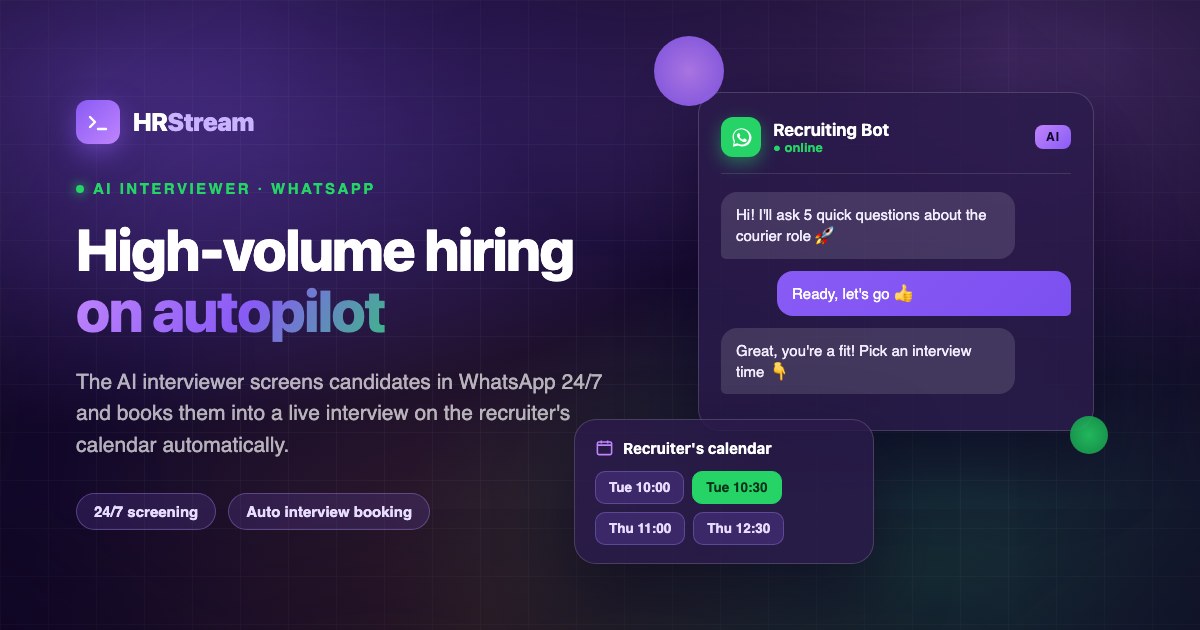
- Within a minute, a WhatsApp message arrives. The AI interviewer introduces itself on behalf of the company and explains the format: "Hello! I'm the recruiting assistant at Company X. I'll ask a few short questions about the sales associate role — it will take 5 minutes."
- The candidate replies in the chat — by text or voice messages, whenever it's convenient for them. No need to call anyone, wait on hold, or work around the recruiter's business hours.
- The AI asks scripted questions — it checks the key criteria, asks follow-ups, and answers the candidate's questions about the job (schedule, salary, conditions).
- At the end, the candidate either receives an invitation to a live interview with a choice of convenient time, or a polite rejection — all of it without a single call from a recruiter.
What this gives the business
- Instant first contact. The candidate gets a message a minute after applying, not two days later. While a competitor is still getting ready to call, your AI has already run the interview.
- The entire flow gets handled. The AI interviewer runs hundreds of conversations at once. 500 applications for one opening is no problem: every candidate gets attention.
- Around-the-clock operation. A candidate applied at 11 PM on a weekend — the AI responds right away. Screening isn't tied to the recruiter's working hours.
- A single evaluation standard. Every candidate goes through the same script and is assessed against the same criteria. Results are comparable and objective.
- Recruiters focus on people, not filtering. Only those who pass screening reach a live recruiter. The freed-up time goes into quality interviews and closing openings.
Two modes: flexible dialogue and strict script
Not every high-volume hire is the same. In some cases it's crucial to strictly verify formal criteria; in others, to assess how a person reasons. That's why the HRStream AI interviewer works in two modes.
Scripted mode
The recruiter defines an exact sequence of questions — a "playbook." The AI follows it strictly in order, records the answers, and evaluates them by set rules. Ideal for formalized filtering: checking age, citizenship, a health certificate, availability for shift work, a driver's license. Here what matters is predictability and being identical for everyone.
AI-led dialogue mode
The AI leads the conversation more freely: it asks the baseline questions but can clarify an incomplete answer, dig deeper into the candidate's experience, and respond to a question back. It suits roles where communication, motivation, or basic soft skills matter — for example, call center operators or sales managers.
Knockout questions
In any mode you can set knockout questions — criteria without which a candidate simply isn't a fit. No category B license for a courier-driver? Not available for night shifts? The AI ends the conversation gracefully and doesn't waste the candidate's or the recruiter's time. And the rejection is always polite — the candidate experience doesn't suffer.
Evaluating candidates against the job profile
The AI interviewer doesn't just collect answers — it evaluates them. In HRStream you can configure an ideal candidate profile for each job: key requirements, desirable qualities, priorities. After the interview, the AI:
- Matches the answers against the profile and assigns a fit score.
- Produces a short summary for each candidate: which questions they answered, what they said on the key criteria, where the doubts are.
- Ranks the candidates — the recruiter sees a funnel sorted by relevance and works with the best fits first.
The recruiter opens a candidate card and immediately sees the screening result, the score, and the full transcript of the dialogue with the AI. No need to listen to call recordings or decipher notes — everything is structured.
The key part: booking a live interview on the recruiter's calendar
This is where high-volume hiring most often stalls. The candidate passed the screening — and a multi-day ping-pong begins: "When works for you?" — "How about Tuesday?" — "No, Tuesday's taken, let's do Wednesday" — "Wednesday I can't." Every time-coordination step is several messages and lost hours. Across a flow of hundreds of candidates, this turns into a full-time job of its own.
HRStream solves this through candidate self-booking into a slot on the recruiter's calendar — right there in the same WhatsApp chat, with no human involved.
How it works
- The recruiter sets availability windows. For example: "interviews on Tuesdays and Thursdays from 10:00 to 13:00, 30-minute slots." The system slices the windows into concrete slots itself.
- The candidate passes the AI screening successfully. The AI recognizes that the candidate is a fit and moves on to the next step.
- The AI offers open slots right in WhatsApp. "Great, you're a fit for us! Let's schedule a meeting with the recruiter. Pick a convenient time:" — followed by a list of available slots.
- The candidate picks a time and books it — with a single message or by following a link. The slot is taken instantly and is no longer offered to other candidates.
- The booking is created in the system. A meeting appears on the recruiter's calendar, linked to the candidate's profile and screening results. The candidate receives a confirmation with the details.
What matters here
- Zero manual coordination. The recruiter sets availability windows once — from there the system schedules the meetings on its own. The calendar fills up without a single "when works for you" message.
- No double bookings. The moment a slot is taken, it disappears from the offer. Two candidates can't book the same time.
- Rescheduling without calls. If a candidate's plans change, they reschedule via a link — picking another open slot. The recruiter doesn't have to rework the schedule by hand.
- Automatic reminders. The candidate gets a reminder about the meeting, which lowers the no-show rate — a sore point of high-volume hiring.
The result: the path from application to a booked live interview runs fully automatically. The recruiter steps in only at the final, most valuable stage — when the person across from them is an already-screened, motivated candidate booked for a specific time.
Knowledge base: the AI answers candidates' questions
In high-volume hiring, candidates ask the same questions over and over: "What's the salary?", "What's the schedule?", "Where's the office?", "Is there training?". Answering them by hand hundreds of times is exhausting.
You can connect a knowledge base about the company and the job to the HRStream AI interviewer. The AI pulls answers from it and responds to the candidate accurately and in context: if someone asks about the conditions, the AI explains, then returns to the interview questions. The candidate gets answers instantly, and the recruiter is spared the routine.
A seamless handoff from AI to a live recruiter
A core principle of HRStream: for the candidate, everything happens in a single WhatsApp chat. First the AI runs the screening and books the meeting, then — if needed — a live recruiter writes into that same chat. The candidate doesn't notice the "handoff": they see one continuous conversation with the company.
The recruiter, in turn, opens the dialogue and sees the full context: what the AI asked, how the candidate answered, what the score is, and what time the meeting is set for. Nothing is lost, and nothing needs to be re-asked.
A corporate number, not a personal phone
The AI interviewer works through the official WhatsApp Business API — on the company's corporate number, not on the recruiter's personal phone. Here's what that gives high-volume hiring:
- Candidates message the company number. When a recruiter leaves, all the correspondence stays in the system.
- Several recruiters, one number. The team works from a shared flow, and each person sees their own dialogues.
- Stability at scale. The Business API is built for mass communication and doesn't get blocked, unlike ordinary WhatsApp Web.
- Candidate trust. The message comes from a verified business account with the company's name and logo.
A practical case: hiring 100 couriers
Let's show the effect with a concrete example — a logistics company hiring 100 couriers in a month.
Without the AI interviewer
- 2,000 applications in a month. Each one needs a call for the initial check.
- A recruiter calls around 40 candidates a day, connecting on the 3rd or 4th attempt.
- First contact with a candidate happens 2–3 days after applying. A third of them are already employed elsewhere.
- Coordinating an interview time — another 3–5 messages per person.
- It takes 3–4 recruiters just for the initial screening.
With the HRStream AI interviewer
- All 2,000 candidates get first contact within a minute of applying.
- The AI runs screening around the clock, whenever it's convenient for the candidate.
- Roughly 600 shortlisted candidates reach the recruiter, already booked into specific interview slots.
- Zero manual time coordination — the calendar fills itself.
- One recruiter is enough to run the final interviews and make decisions.
The result:
- Time to first contact — from 2–3 days down to 1 minute.
- Share of applications processed — from 60–70% up to 100%.
- Recruiter screening load — cut by a factor of 3–4.
- Fewer lost candidates thanks to speed and slot booking.
Pricing and getting started
The HRStream AI interviewer is billed on actuals — for interviews conducted, not for abstract "leads." During the trial period, free interviews are available so you can evaluate the tool on your real flow before any payments. That makes entering high-volume hiring automation predictable on budget.
Security and handling personal data
- An official channel. Integration through Meta's WhatsApp Business API, with no gray-market schemes.
- Storage compliant with Kazakhstan law. Candidate data is processed in accordance with the Law "On Personal Data and Its Protection."
- Access control. Roles determine who sees which dialogues and data.
- Audit trail. Every action is logged — transparency for compliance.
How to launch the AI interviewer
- Sign up for HRStream — the trial period is free.
- Connect the WhatsApp Business API — a corporate number for communicating with candidates.
- Set up the screening script — questions, criteria, knockout conditions. The AI will help generate the script text from the job's details.
- Define interview availability windows — the days and hours when the recruiter is ready to hold meetings.
- Launch the job — and the AI will start screening candidates and booking meetings automatically.
Frequently asked questions
Will the candidate realize they're talking to a bot?
The AI interviewer introduces itself as a recruiting assistant. We're for transparency: the candidate understands the format, yet the conversation stays natural — in the familiar WhatsApp chat, without robotic buttons and menus.
What if the candidate answers off-topic or asks a question back?
The AI understands free-form text and voice messages. It will answer the candidate's question (using the knowledge base about the job) and gracefully return to the interview. This isn't a rigid command tree — it's a real conversation.
How much can you trust the AI's assessment when making a decision?
The AI doesn't make the hiring decision — it handles the initial filtering and prepares a structured summary. The final decision always rests with the recruiter, who sees the full transcript and score. The AI saves time on routine; it doesn't replace human judgment.
What about no-shows to scheduled interviews?
Candidates receive automatic meeting reminders, and rescheduling is available via a one-click link. This noticeably reduces the no-show rate compared with phone arrangements.
Is this suitable for smaller hiring, not just high-volume?
Yes. Even with a handful of openings, the AI interviewer takes the routine of first contact and time coordination off the recruiter's plate. But the tool delivers its maximum effect precisely at scale, where manual processing physically can't keep up.
Conclusion
High-volume hiring is about speed and scale. The winner is whoever reached the candidate first, handled the entire flow, and didn't lose people to scheduling. The HRStream AI interviewer addresses exactly these tasks: instant contact in WhatsApp, around-the-clock screening of the whole flow, objective evaluation against the job profile, and — crucially — automatic booking of shortlisted candidates into a live interview on the recruiter's calendar.
Key benefits:
- First contact with a candidate — within a minute of applying, 24/7.
- Screening hundreds of candidates at once, without growing the recruiting team.
- A single, objective evaluation standard based on the job profile.
- Automatic booking into a live interview on the recruiter's calendar — no manual coordination and no double bookings.
- A seamless handoff from AI to a live recruiter within one WhatsApp chat.
- Pay for interviews actually conducted, with a free start.
Try HRStream for free and launch the AI interviewer on your own flow of candidates — see how automation changes the economics of high-volume hiring.